
WASHINGTON — ICYMI, Citizens for Responsible Energy Solutions (CRES) named Tim Moore (R-N.C.) CRESponsible leader for the month of April. Each month, CRES highlights a member of Congress for their leadership on clean energy policy.
As CRESponsible Leader of the Month, Rep. Moore shared his insights with CRES on North Carolina’s energy leadership. He highlighted the importance of comprehensive permitting reform, the need to strengthen our nuclear buildout and critical mineral supply chains and the excitement behind North Carolina’s energy future.
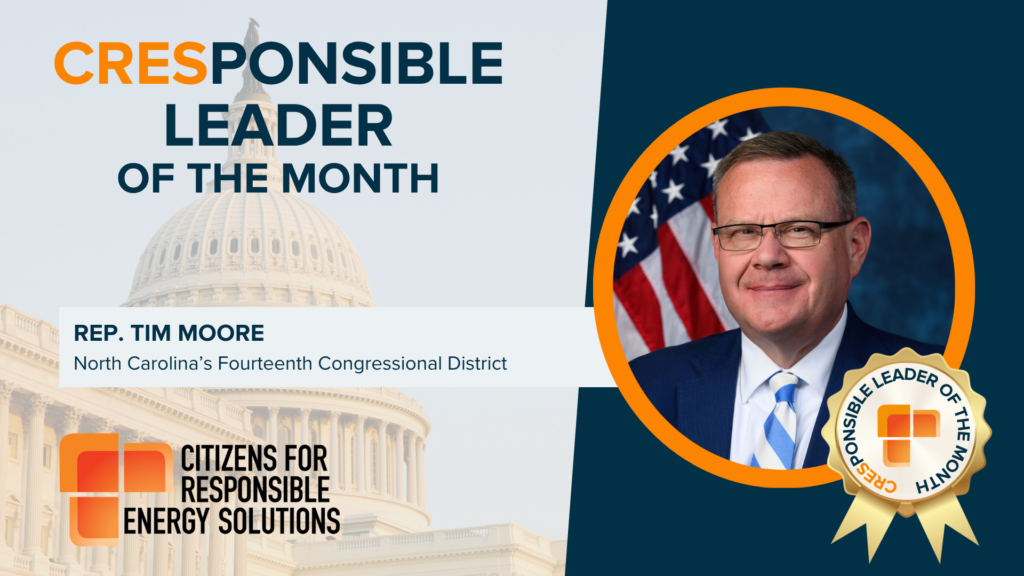
Read the full interview below:
Representative Moore, you’ve been a strong advocate for advancing next-generation energy technologies, including nuclear. How do you see technologies like advanced nuclear shaping America’s energy future and strengthening our global leadership?
I believe advanced nuclear energy is going to play a major role in America’s future, and that is exactly why I introduced the Next Generation Nuclear Deployment Act. Right now, we have incredible innovation happening, but too often it gets slowed down because there are not enough places to test and deploy these technologies. My bill expands the Department of Energy’s Advanced Reactor Demonstration Program to at least ten sites across the country and opens the door for private companies to use their own land or other federal sites. That means we can move faster and get real projects off the ground. I also made sure we prioritize a micro reactor demonstration because these smaller systems can deliver reliable power in places where traditional energy sources fall short, including rural areas and disaster zones.
When I talk to folks back home, I remind them that energy is the foundation for everything we want to build. The growth of artificial intelligence, advanced manufacturing, robotics, you name it, will require a level of energy production we have not seen before. Advanced nuclear is one of the best ways to meet that demand while keeping energy reliable and affordable. It also strengthens our national security by powering military operations and supporting missions such as our return to the Moon. If America leads in this space, we set the standard for the world. If we fall behind, we give that advantage to countries like China, and that is not a risk I am willing to take.
You’ve also taken steps to strengthen U.S. supply chains through your Critical Minerals Trade Security Act. How can securing critical minerals help reduce reliance on foreign adversaries and support both our economic and national security?
I see critical minerals as one of the most important economic and national security issues we are facing today. These materials are essential for us to compete with our foreign adversaries in high-tech manufacturing and defense applications. Right now, too much of the global supply chain is controlled by countries that do not share our interests. My legislation takes the first step in addressing this gap by creating a Chief Critical Minerals Negotiator within the Office of the United States Trade Representative. This role would lead a coordinated strategy focused on securing supply chains and strong trade agreements, while also identifying risks before they become serious problems.
This issue is especially important for my home state of North Carolina. My district specifically is home to valuable lithium resources that are necessary for batteries and energy storage. If we invest in domestic mining and refining, we can reduce our dependence on China and strengthen our position in the global market. I want to see those jobs created in places like western North Carolina, not shipped overseas. At the end of the day, this is about making sure America is not left vulnerable. When we control our supply chains, we protect our economy and strengthen our workforce while putting our country in a stronger position for the long run.
North Carolina is home to key resources like lithium and quartz that are essential for modern technologies. Why is permitting reform needed to unlock these resources while ensuring projects move forward responsibly and efficiently?
I hear from businesses and local leaders all the time that one of the biggest challenges they face is simply getting projects approved. We have the resources right here in North Carolina, including lithium and quartz that are essential for modern technology, but projects can sit for years waiting on permits. That kind of delay causes businesses to pull back, forfeiting good-paying jobs and real opportunities for rural communities to grow. If we want to rebuild American manufacturing and compete globally, we have to fix that process.
Duplicative processes and unnecessary bureaucratic red tape need to be cut back by setting firm timelines for approvals and requiring agencies to coordinate instead of operating in silos. Right now, the same project can bounce between agencies with no clear endpoint, and that is where delays pile up. If we require decisions within a set window and hold agencies accountable for meeting those deadlines, we can keep projects moving without lowering standards.
We also need to limit the ability for projects to get tied up in endless litigation after they have already cleared the review process. At some point, there has to be certainty that a project can move forward. If we put those guardrails in place, we can unlock investment, create jobs here at home, and actually follow through on rebuilding American manufacturing rather than just talking about it.
Permitting reform can unlock thousands of U.S. energy projects trapped in burdensome red tape and litigation. What more can Congress do to ensure permitting reform becomes a legislative reality, and do you think it’s possible we see it cross the finish line this year?
The key to getting permitting reform across the finish line is turning the progress we have already made into lasting law. President Trump has taken important steps to cut red tape at the agency level, and Congress needs to codify those actions so they cannot be reversed by future administrations. That is the kind of certainty this industry needs. I have also supported several pieces of legislation aimed at expanding American energy and streamlining approvals, including the Unlocking our Domestic LNG Potential Act, the Reliable Power Act, the Energy Choice Act, and the SAMS Act. These efforts are all focused on making sure we can build the infrastructure needed to meet growing energy demand here at home.
As for timing, I do think there is a real opportunity to get permitting reform done this year if we stay focused. There is growing recognition on both sides that the current system is not working, and folks back home expect us to deliver results.
When you think about North Carolina’s energy future, what excites you most about the opportunities ahead for your state, district, and your constituents?
What excites me most about North Carolina’s energy future is the growth we are seeing across the state. We have become the fastest-growing state in the country, and that growth is reaching beyond our major cities into rural communities. That creates new opportunities for families who want to build a life and career close to the towns where they grew up. I have seen firsthand how investment can transform communities, and I believe we are just getting started.
The Charlotte region has developed into a strong energy hub with a diverse mix of power sources, including natural gas, nuclear, hydroelectric, and traditional generation. That balance gives us reliability and flexibility as demand continues to grow. As new technologies come online and energy needs increase, North Carolina is in a great position to lead. For the people I represent, that means more jobs and stronger local economies, with our state continuing to lead in innovation and growth.