
WASHINGTON — ICYMI, Citizens for Responsible Energy Solutions (CRES)named Rep. Jeff Hurd (R-Colo.) CRESponsible leader for the month of December. Each month, CRES highlights a member of Congress for their leadership on clean energy policy.
As CRESponsible Leader of the Month, he shared his insights with CRES on Colorado’s leadership in the energy space, the importance of comprehensive permitting reform and how an all-of-the-above energy approach plays a role in shaping the state’s energy future.
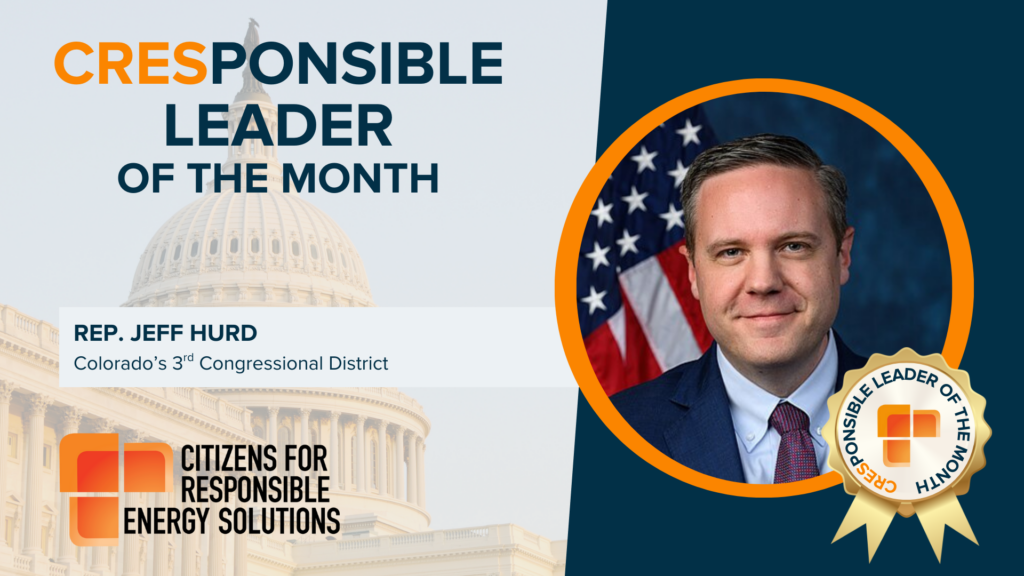
Read the full interview below:
1. Colorado is a very important state for energy in the United States, and you have been supportive of an all of the above energy approach. How do you see that working in practice for Colorado and the country?
Colorado’s Third District embodies America’s energy potential, including fossil fuels, renewables, and emerging technologies. An all of the above energy approach means putting these resources to work to deliver energy that is affordable, reliable, secure, and export ready. This is not abstract. It is about real jobs, strong supply chains, and stable communities.
In practice, this means responsibly producing the resources that power our economy today while investing in grid modernization, expanding transmission, and supporting innovation in energy technologies. We should use the full range of American energy assets to meet demand, strengthen our economy, and maintain global leadership.
2. How should we continue to improve and incentivize an all of the above energy approach in America?
To succeed, federal policy must provide certainty rather than uncertainty. That means clear rules that support innovation across the energy economy, sustained investment in research and development, and infrastructure that moves energy efficiently to market.
Regulatory predictability is essential so businesses, utilities, and communities can plan and invest with confidence. Whether supporting traditional energy, renewables, or emerging technologies, the goal should be to expand American energy capacity while strengthening competitiveness and reducing emissions.
3. CRES supports streamlining permitting processes to responsibly accelerate clean energy and infrastructure projects, especially through efforts like the SPEED Act. Why is comprehensive permitting reform necessary, and how will bills like the SPEED Act support expanding energy production in the United States? Do you have specific examples from your district?
Too often, projects that should take a few years are delayed for a decade by a permitting system that is slow, duplicative, and unpredictable. This undermines American competitiveness and discourages investment in energy and infrastructure projects of all kinds.
That is why I have worked on permitting reform measures, including provisions in the PERMIT Act that reduce backlogs, limit duplication, and bring clarity to reviews under major environmental statutes. Efforts like the SPEED Act build on this work by standardizing permitting timelines and providing greater certainty for developers.
In western Colorado, this directly affects transmission needed to bring renewable energy to market, as well as upgrades to water systems, broadband expansion, and other critical infrastructure. Fixing the permitting process helps deliver these projects faster and more responsibly.
4. Permitting reform is not just needed for energy projects. It is needed to build all of our infrastructure. How is your work on the Transportation and Infrastructure Committee complementing other permitting reform efforts?
Permitting challenges affect every type of infrastructure, including roads, bridges, water systems, ports, and broadband networks. On the Transportation and Infrastructure Committee, I have focused on reducing redundancy, improving coordination among agencies, and strengthening the role of state and local decision making.
Streamlining permitting helps infrastructure projects move faster, cost less, and deliver benefits sooner. For rural areas in Colorado, that translates directly into improved safety, economic opportunity, and quality of life.
5. What are you doing to make sure rural areas benefit from new energy and infrastructure projects?
Supporting rural communities is a priority in everything I do. Energy and infrastructure projects create jobs, strengthen local economies, and improve connectivity for families and businesses.
In Congress, I introduced the Airport TIFIA Financing Certainty Act to expand access to federal financing for rural airports, which are critical to local economies. I also introduced the Productive Public Lands Act to support job creation while ensuring public lands are managed responsibly for future generations. These efforts help ensure western Colorado’s rural communities share in the benefits of our nation’s energy and infrastructure progress.